
Clients say polished when they mean expensive. They say brushed when they mean café. Both words hide a grit number. The old catalogue already knew the useful split: No. 4 as the general-purpose brushed kitchen finish, No. 8 as the highly reflective polish, BA as the mill’s own almost-mirror.
Choose the finish for the way the surface will be seen, washed and scratched — not for a showroom photo. This journal does not sell sheet. It still has to decode the words, because “polished stainless” on a cut list is how a 2B offcut, a BA coil and a No. 8 panel end up on the same elevation.
The longer decoder for mill names is finishes explained. This page is the argument that happens in kitchens, on rails, and on balconies.
The words people use, and the finishes they mean
In trade English, “brushed” almost always means a directional satin: No. 4, or a shop belt that is trying to be No. 4. “Polished” might mean BA sheet, a 320-grit rail, or a No. 8 mirror. “Satin” is sometimes a finer No. 4 and sometimes a salesperson avoiding a number. “Mirror” is a client word that may or may not survive contact with a sample.
Ask which. Then write the number, the grit, and the grain. Point at a physical sample. Do not point at a phone photo taken under a café pendant.
| Client word | Safer specification | Hides wear? | Shows fingerprints? | Repairable on site? |
|---|---|---|---|---|
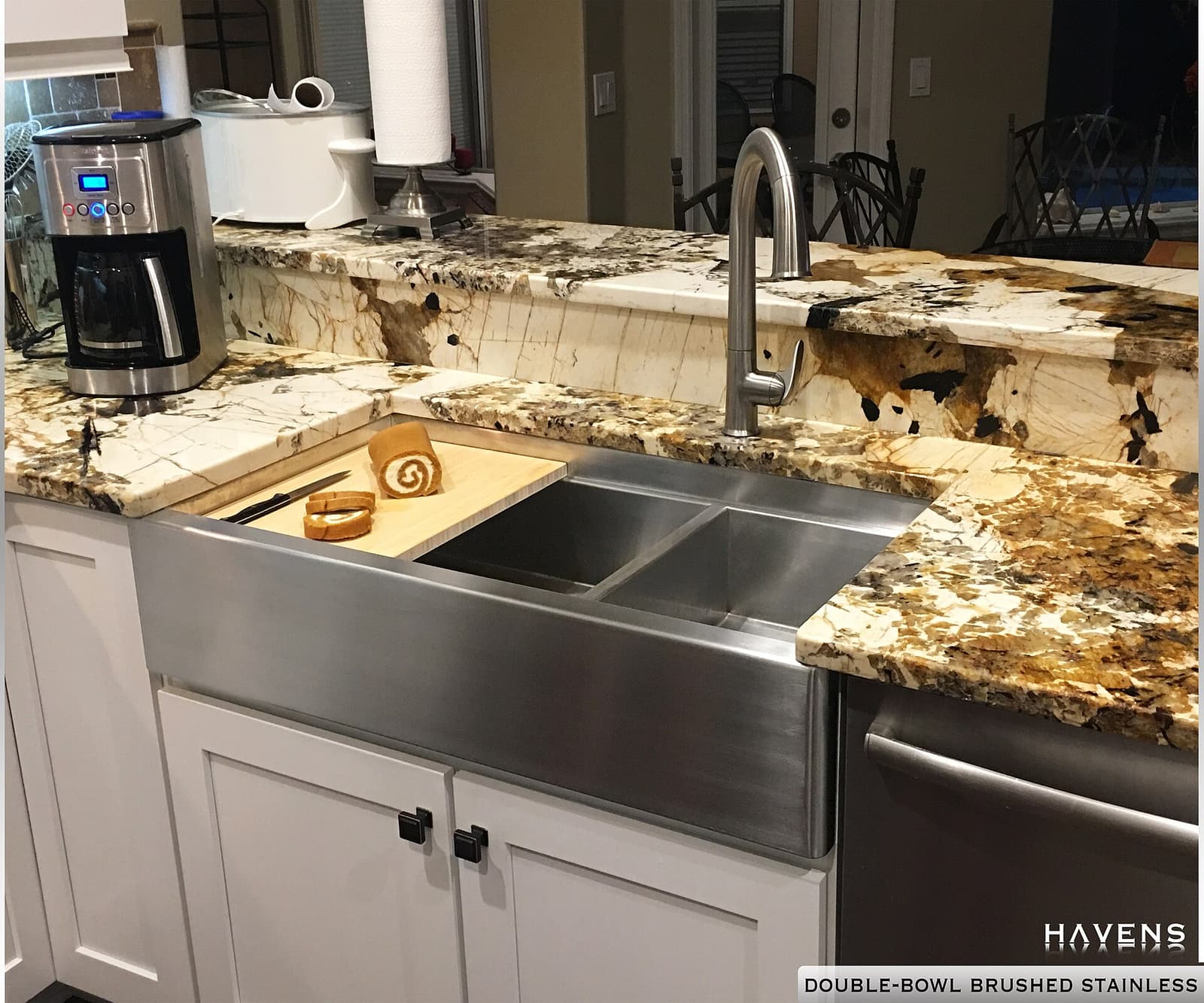
| Brushed / café / satin | No. 4, grit named, grain long | Yes, along the grain | Less than a mirror | Yes, with a stainless-only pad |
| Polished rail | 320-grit (or named) polish, alloy named | Some | More | Sometimes, if you can re-polish |
| Mirror / feature | No. 8, filmed, handling plan | Almost never | Always | No — dents stay public |
| Soft mirror / shiny mill | BA, with a sample | Poorly | Yes | Poorly — mill variation remains |
If the job is 304 versus 316, decide the alloy first. A perfect polish on the wrong alloy is still a coastal stain.
What brushed actually is
A No. 4 is a directional satin. Light breaks along the grain. Fine scratches from pans run with that grain and disappear; they scream when they cut across it. That is why grain direction belongs on a benchtop drawing and on every line of a custom-cut list.
A coarse shop brush can look rustic and collect food. A fine architectural satin can look almost like a dull polish. Neither is “the” No. 4. Grit is a process, not a brand. Two shops can both stamp No. 4 and disagree under a downlight. If adjacent panels must match, they should come from the same parent sheet, same belt, same grain.
Brushed is the default for food-grade work because it is repairable. You can blend a ding. You cannot invisibly blend a dent in a true mirror. That is the practical reason Australian kitchens stay on No. 4 even when a mood board said “contemporary.”
Dirt still sits in a coarse grit. A 120-grit face in a meat room is harder to sanitise than a finer satin. Hygiene is not the same as hiding scratches. Write the grit for the duty.
Grain on a nest
Australian merchant sheets are typically 2400 × 1200, with 3000 × 1500 and 3600 × 1500 on many racks depending on thickness and finish. Grain usually runs the long way of the parent, but you must ask. A splashback cut across the grain next to one cut with the grain will read as two metals.
The old custom-cut practice published a ±2 mm shear tolerance and warned that a cut edge is not an extrusion. Grain does not forgive a staggered nest. If the elevation is a long run of No. 4, nest for grain first and yield second.
What polished actually is
Polished, in trade English, might mean BA sheet, a 320-grit rail, or a No. 8. BA is a mill finish: bright, sometimes cloudy, coil-variable. A 320-grit 316 balustrade is a common Australian look — smooth enough to wash, still a polish. A No. 8 splashback behind a cooktop is a fingerprint farm and a distortion mirror for every pot.
Smoother metal can be more corrosion-resistant in the sense that it holds fewer deposits. That advantage dies if the polish is scratched with a carbon-steel wool pad. Cleaning without chloride damage matters more on a mirror than on a satin, because every mark is public.
Welds on a polished face are a finish project of their own. A TIG bead ground and re-polished to No. 8 is specialist work. A TIG bead left as-welded on a “mirror” splashback is a stripe. If the drawing shows a polished return and a welded corner, budget the dress or change the detail to a fold.
BA is not No. 8
Bright annealed can look expensive in a rack photo. Beside a mechanically polished No. 8 it often looks softer, slightly cloudy, and less even. The old Melbourne catalogue already treated BA as mirror-adjacent, not as a perfect mirror. If the architect’s sample is a No. 8 plaque and the merchant’s stock is BA, you do not have a match. You have a meeting.
Coastal and outdoor
Outdoors, a polish is a statement and a maintenance contract. Salt sits in every remaining scratch. Tea staining photographs better on a mirror. If the client wants the gleam, specify 316, a grit you can wash, drainage, and a care sheet.
Inland, 304 outdoors can be honest. At the beach, 304 polished is a brown photograph waiting for summer. The finish does not replace the alloy.
A brushed outdoor rail still needs washing. Grain holds a film of salt if nobody rinses it. The difference is that a No. 4 can look acceptable between washes; a No. 8 looks dirty the afternoon after a northerly.
Protecting stainless during install is not optional on polished work. Film stays on until handover if the sun will allow it. Carbon-steel swarf from a neighbour’s grinder will rust on a 316 polish and the client will blame the alloy. If you must cut on site, read cutting stainless sheet on site before you pick up an angle grinder.
Thickness, folds and the edge you will see
Finish travels with thickness. Thin polished sheet oil-cans and shows every hollow. Thick polished sheet is heavy, expensive to polish, and may not exist in the parent size you drew. The thickness chart is the millimetre page; this page only needs to say: do not specify No. 8 in 0.9 mm and expect a flat splashback.
Folds on brushed sheet will break the grain around the radius. That can look intentional on a tray and accidental on a long folded angle. Decide grain before the folder, not after. A folded channel with grain running across the web will read differently from one with grain along it.
Guillotine, laser and waterjet all cut polished sheet. The guillotine is the historic custom-cut tool: fast, cheap, ±2 mm, a sheared arris. Laser and waterjet can leave a cleaner edge and a tighter window if you paid for them. None of them is a mill-extruded edge. If the polished edge is a feature, say so and budget a dress.
A specification that ends the argument
Write “No. 4, 180–240 grit, grain long, PVC on” or “320-grit polish, 316L, film on until handover.” Point at a sample. Do not point at a phone photo.
If the job mixes metals, do not let “polished stainless” sit next to a zinc rail painted silver and hope the light is kind. The comparison page is stainless versus galvanised versus aluminium.
For handling, see protecting stainless during install. The mill-floor map sits on the sheet, plate and finishes hub. Blanks and folds sit on the custom-cut and sections hub.