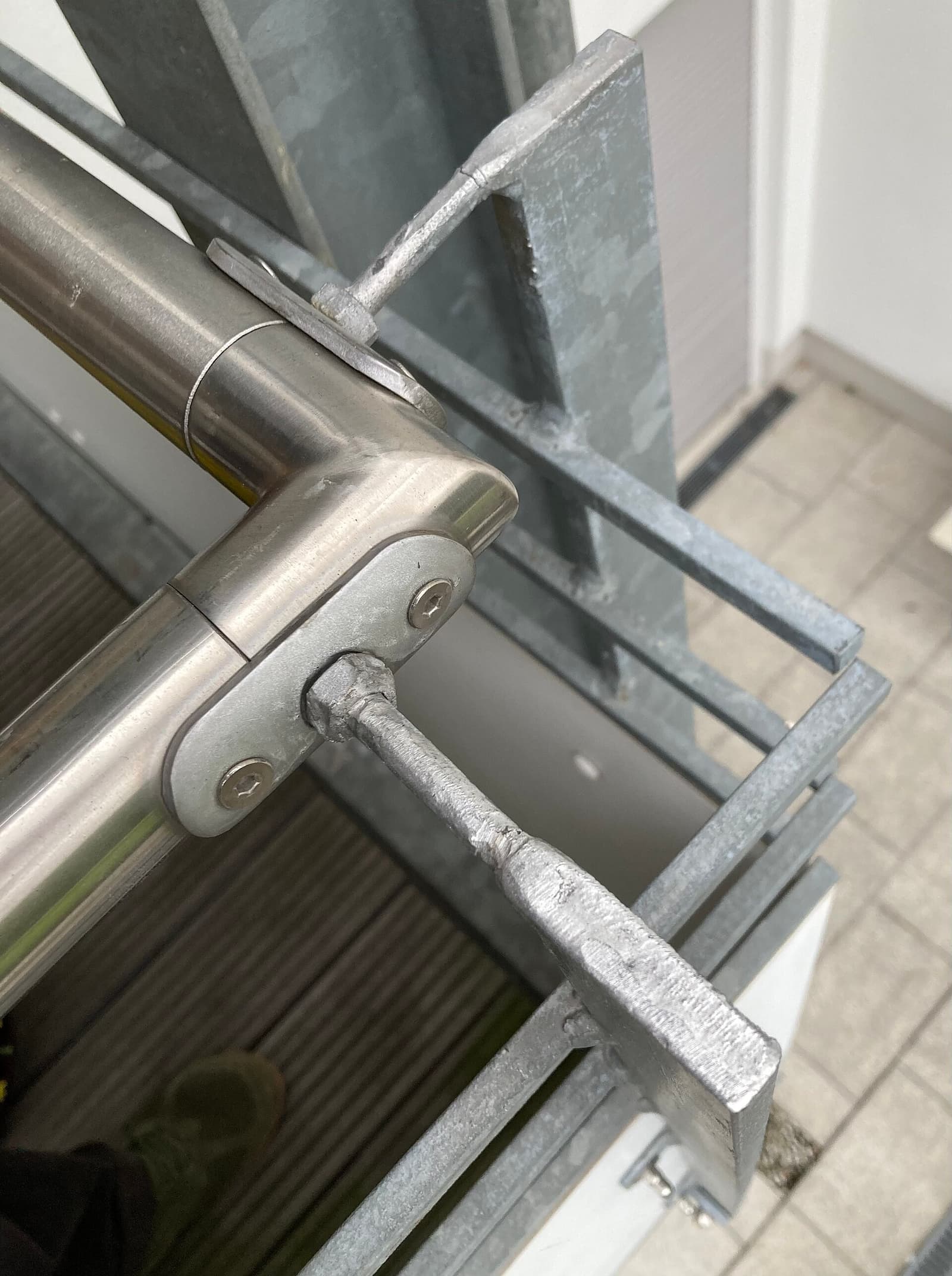

A 316 rail on A2 screws is a 304 stain at every hole. Fastener designations are the quiet language of the trade: A2 ≈ 304, A4 ≈ 316. The old shop could sell you beautiful tube and still lose the job in the hardware tin.
This journal does not sell bolts. It will not quote a live price. It will tell you that the cheapest way to undo a 316 balustrade is to grab the unlabelled mixed tin. ASSDA’s fastener notes and Atlas Steels grade data for 304 and 316 are the chemistry underneath the ISO-style A2 / A4 marks. Australian coastal chlorides do not care that the tube was specified correctly if the screw was not.
The marine, balustrade and outdoors hub is where most of these bags get opened. The grades and alloys hub is the family tree.
Chemistry under the head mark
A2 is the fastener designation aligned with 304-type austenitic chemistry: chromium-nickel, no useful molybdenum. A4 aligns with 316-type chemistry: the molybdenum that helps in chlorides. That is the same split as 304 versus 316, written for a hex head instead of a sheet.
“Marine grade bolts” is the same nickname problem as marine-grade stainless. Write A4. If the duty is immersed seawater or plant chlorides, you may already be past A4 and into a specified alloy — sometimes duplex hardware, sometimes something the engineer named. Do not invent that upgrade from a barbecue brochure.
| Mark / phrase | Chemistry family | Australian honesty |
|---|---|---|
| A2 / A2-70 | 304-type | Indoor 304 work, dry interiors |
| A4 / A4-70 | 316-type | Coastal, pool, 316 fabrications |
| “Stainless” unmarked | Unknown | Not A4 |
| Zinc / gal | Carbon steel, coated | Not on a 316 rail |
| Magnetic “stainless” screw | Could be 430-type or a duplex, or a fake | Identify before you install |
Head marks are not decorative. If you cannot read them, you cannot specify the atmosphere. 430 fasteners exist in some appliance worlds; they are not a coastal rail screw.
When to write A4
- Coastal and marine atmospheres.
- Pool surrounds.
- Any fabrication already specified 316.
- Outdoor balustrades and barbecue assemblies.
- Food rooms that already specified 316 for chlorides — see food-grade stainless.
A2 is fine in a lot of indoor 304 work. It is not “stainless, close enough” on a pier. A2 in a coastal post is how tea staining starts at the hole while the tube still looks new.
Historic Melbourne custom-cut jobs named the sheet grade and still lost the photograph at the base plate because the installer used roofing screws from the ute. The docket is not finished when the tube is named.
Property classes
A2-70 and A4-70 are common strength classes. The “70” is not a corrosion rating. A4-80 is a stronger A4, not a different alloy family. Structural hold-downs may need a specified class and a specified anchor, not a roofing screw from a jar.
This journal will not pick your chemical anchor. It will not pretend a blog is a building-surveyor certificate. It will say: the metal of the screw should not be the weak corrosion link, and the property class should be the one the designer wrote.
Mixing property classes in one connection because the tin was mixed is how a joint has one shank yielding early. Mixing A2 and A4 in one coastal run is how the A2 heads photograph first.
Galling
Austenitic nuts and bolts love to seize. The same nickel-rich, work-hardening behaviour that makes 304 and 316 tough in a fold makes threads grab. Dry A4 into dry A4, spun with an impact, is a welded nut with a rounded hex.
Use a suitable lubricant or anti-seize rated for the duty. Stainless-on-stainless in a food room needs a compound the plant will accept; a coastal rail needs something that will not become a dirt cake in a crevice. Controlled speed. The right nut. Do not force a dry pair and then blame the grade.
Galling is not proof you bought the wrong family. It is proof the assembly method ignored austenitic behaviour — the same family behaviour discussed in welding 304 and 316 when people treat stainless like mild steel.
Mixed metals
Zinc, aluminium, copper and stainless in one wet hole is a galvanic short story. Isolate in coastal work. Carbon-steel screws in a stainless bench are how tea staining starts at the tap hole. Protecting stainless during install includes the bag you open last.
A 316 tube with a carbon-steel core and A4 window dressing is still a mixed assembly. A4 cannot redeem a carbon stud in a wet base. Passivation of a fabrication does not passivate a zinc screw you added on site.
Unlabelled mixed tins are not A4. Identify at purchase. Write A2-70 or A4-70 on the purchase order the way you write 304 or 316 on the sheet.
Australian duty: indoor, food, coast
Indoor
A2 on 304 joinery, kickplates, indoor frames. Match the sheet. Do not “upgrade” every indoor cabinet to A4 for theatre unless the room is a wet chemical space.
Food
Hygienic equipment wants a named fastener, not a rusty head above a board. 304 benches often take A2; 316 plant takes A4. Threads in a splash zone are a cleaning problem as much as a corrosion problem. Food-grade language does not replace a head mark.
Coast and pool
A4 is the default. Coastal care includes washing the heads. Ponding at a base plate still pits an A4 shank if you designed a cup. Finishes on the tube will not hide a brown A2 hex.
Duplex structures specified by an engineer need hardware the engineer named — not an assumption that A4 is the top of the mountain. See duplex versus 316.
Failure modes
A2 on a 316 coastal rail. Brown dots at every hole. The tube certificate is irrelevant to the photograph.
Zinc on stainless. White rust, brown rust, a couple you installed on purpose.
Galling and snapped heads. Over-torque, dry threads, impact guns. The replacement bag is still A4 if you write it down this time.
Unmarked bag used as A4. You cannot prove the alloy when the client asks. Treat it as unknown.
Property class ignored. A4-50 used where A4-70 was specified, or the reverse, because someone read “A4” and stopped.
Crevice under a washer. A flat washer that ponds salt against the tube. Design the joint to drain.
Specification language and how to order
Write the designation, the property class, the diameter × length, and the duty. Example: “A4-70 hex bolts M10 × 40, coastal 316 balustrade, anti-seize as specified, no zinc substitutions.”
Refuse “stainless screws, marine grade” on a purchase order. Ask for A4 and a pack that is still sealed. Keep a spare marked pack on the job, not a communal tin.
If the sheet is 316L, the fastener is A4 unless the designer wrote a higher alloy. If the sheet is 304 indoor, A2 is honest. If the sheet is 430, do not pretend A4 will make the panel coastal.