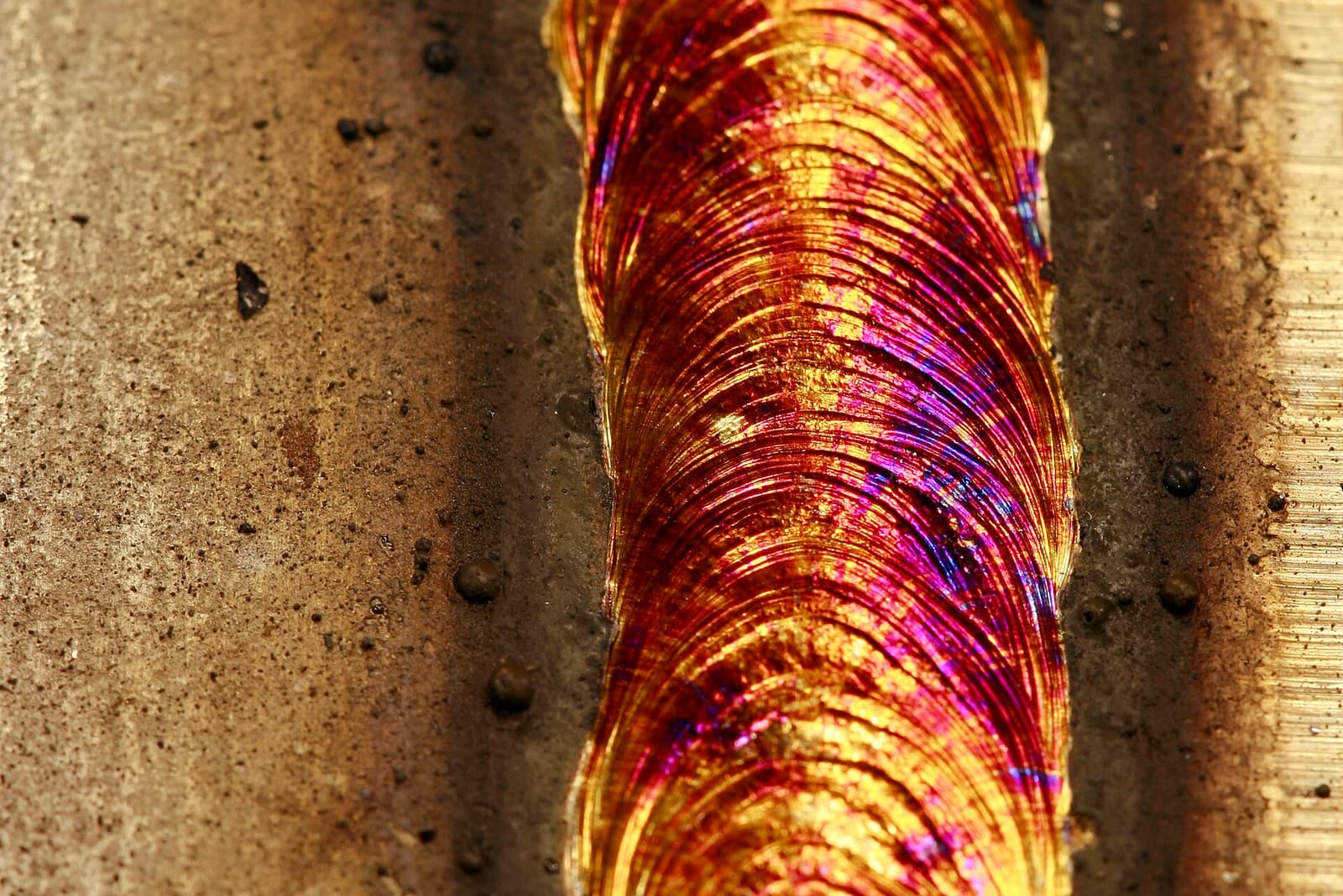

Tea staining is the Australian name for the brown film that appears on stainless that thought it was finished. ASSDA has written this up for years. The old Melbourne shop warned that 316 in marine environments can show brown staining. Both are describing the same chemistry: chlorides, moisture, a surface that holds deposits, a passive film that is locally busy.
It is not proof the merchant sold you 430. It might be. Test before you shout — identify the grade.
This essay sits in fabrication and care because the stain is usually earned after the shear: a weld left tinted, a base plate that ponds, a bleach wipe, a week of salt that nobody hosed. The metal can be honest 316 and still go brown. That sentence is the one clients do not want and fabricators need.
Why Australia is good at it
Salt air, coastal suburbs built to the sand, pool fences, and a climate that dries deposits onto metal. Horizontal rails, base plates that pond, and unsealed welds are designed-in crevices. Carbon-steel swarf from a site cut is a second, uglier stain — see cutting on site.
316 resists pitting better than 304. It does not repeal the weather.
ASSDA’s public tea-staining guidance is written for this country. Chlorides arrive as sea spray, pool chemical, food salt, and the dust that sits in a coastal crevice and stays wet overnight. A dry inland town is a different test. Bondi, a surf club, a marina ladder and a tenth-floor “inland coastal” rail are not the same test either, but they all beat a laboratory coupon that was rinsed on a schedule.
Heat makes it faster. A north-facing rail that bakes the salt on will stain sooner than a shaded vertical. That is not a statistic. It is what a hose and a pair of eyes already know.
Alloy, finish and the surface that holds salt
304 outdoors near salt is a callback with a mill certificate. 316 is the default coastal austenitic and still tea-stains. The old Alltrade catalogue already said 316 is not fully seawater-proof. Marine-grade language is a nickname, not a force field.
Rough surfaces hold deposits. A coarse grind, an undressed weld, a mill HRAP heel that faces the weather — they all keep salt wet longer than a smooth, drained, washed face. A mirror polish that then gets scratched is a set of salt trenches. Finish helps. It does not replace coastal care.
Weld zones stain first when tint is left on. Thick heat tint is a damaged film. Welding 304 and 316 and passivation are the shop half of tea-stain prevention. Skipping both and selling a “marine” bead is how the brown line follows the weld exactly.
Fasteners stain first when they are the wrong alloy. A2 versus A4 is not a hardware-store vibe. A2 in a 316 coastal rail is a halo around every hole.
Design and finish
- Drain water. No cups at the post base.
- Smooth enough to wash; not so mirrored that every scratch is a salt trap.
- Specify A4 fasteners so the screw does not become the first brown dot.
- Passivate after fabrication.
- Keep 304 indoors or inland unless you like callbacks.
Coastal care is the maintenance half. Marine-grade language is the sales half.
Horizontal flat bar straps, the inside of a folded channel, and the heel of an angle are dirt shelves. Design them as gutters or accept that they will photograph brown. A custom-cut cover that traps wash water against the post is a stain factory with a neat edge.
Unsealed lap joints and spot-welded labels are crevices. Water sits. Chlorides concentrate as the drop dries. That concentration is why a “little bit of salt” is enough.
What the brown film is, and what it is not
| What you see | Likely name | First move |
|---|---|---|
| Even brown haze on a coastal rail, worse on horizontals | Tea staining | Wash, check drain, check alloy and fasteners |
| Brown stripes under a site cut or grind | Carbon-steel swarf / flash rust | Clean dedicated, isolate tools, do not steel-wool |
| Rainbow or blue-black on a weld, then brown | Heat tint left on | Remove tint, passivate |
| Brown only around screws | Wrong or mixed fasteners | A4, or isolate the odd metal |
| Deep pits, holes, or a flaking core | Not tea stain | Stop, identify the product — core rust or severe pitting |
| Instant rust on a “316” post that grabs a magnet hard | Possibly not 316 | Identify the grade |
Tea staining is surface corrosion on the film. It is ugly. It is not a hole through a 316 tube. Clients still photograph it as rust, and they are not entirely wrong: it is corrosion. They are wrong if they mean the section is carbon steel. Prove it before you rip a balustrade out.
Removal, without making it worse
Neutral detergent and fresh water, often. Dedicated stainless cleaners that ASSDA-type guidance would recognise. Not bleach. Not hydrochloric “brickie” acid. Not steel wool. Cleaning without chloride damage is the kitchen version of the same rule.
If you polish out a stain and leave a coarse scratch, you have installed a future stain. Blend with the grain. Recheck the alloy if staining returns in a week on a supposedly inland 304 post — you may have mixed metals.
A light coastal haze that comes back after every dry week is a wash-schedule problem. Increase frequency after storms. Start at the top. Do not let dirty water dry into a new chloride film. Protecting stainless during install still matters on a finished rail: the next trade’s grinder will restain a face you just dressed.
Steel wool is iron. It cuts, it embeds, it rusts. A carbon scourer on a tea-stained bench is how you turn a haze into a constellation of pits. Stainless-only pads, with the grain, if you must blend. Then wash.
When it is not tea staining
Flash rust from swarf. Heat tint left on a weld. Dissimilar-metal couples. A carbon-steel core in a “stainless” rail. Each has a different fix. This journal will not sell you a miracle wipe. It will tell you to wash the rail, drain the base, and stop believing “marine grade” means “never brown.”
If staining is immediate, striped, and sits under a construction cut, treat it as contamination. If it is a rainbow that was never removed, treat it as tint. If a magnet slams onto a “316 marine post,” treat it as identification. If the brown is only in the internal corner of a U, treat it as design — then read channel versus folded channel and put a drain in the next one.
Passivation after the last site weld is cheaper than a callback polish that scratches the rail. Washing is cheaper than both. Alloy choice is cheaper than a replacement when the job was 304 on the sand.
The fabrication and care hub collects the weld, the film, the wash and the cleaners. Tea staining is the photograph that tells you which of those you skipped.