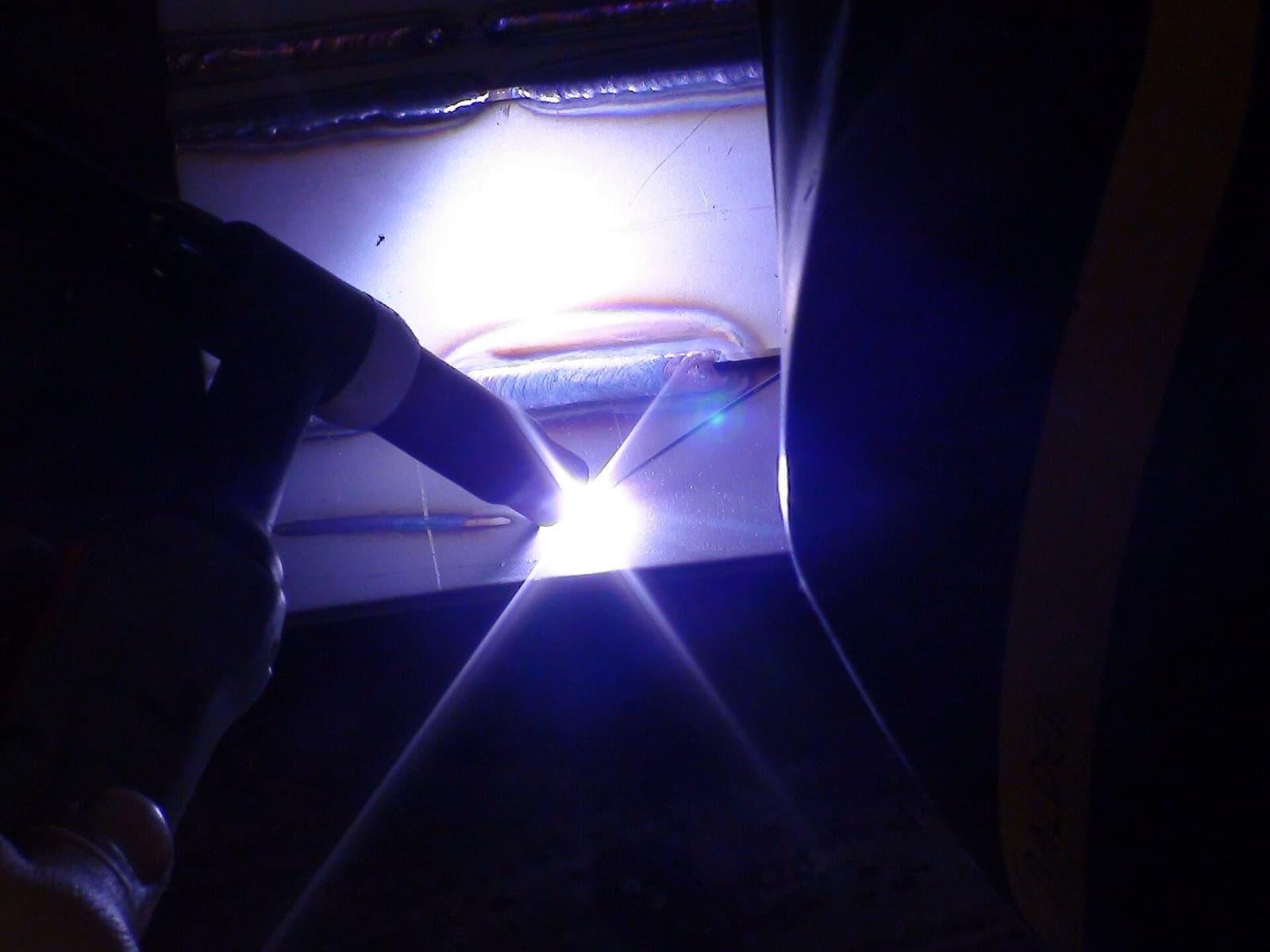

The photograph on this page is the honest part of stainless fabrication: an arc, a puddle, a chance to ruin a good alloy. Australian structural and shop welding of stainless sits under AS/NZS 1554.6 when the work is in that world. A blog is not a WPS. This essay is the briefing you read before you write one, or before you decide the job is a hygienic TIG bead on a bench return.
It lives in the fabrication and care hub because the weld is only half the job. The other half is cleanliness, tint removal, passivation, and the wash that stops tea staining starting on the bead.
Match the alloy, then the filler
304 versus 316 still applies after the clamp. 304/304L typically sees 308L filler. 316/316L typically sees 316L filler. Welding 316 with a 304 filler on a coastal post is how you localise a weaker alloy at the hottest line.
Low-carbon grades (the L) exist to reduce sensitisation — chromium carbides that leave the heat-affected zone easier to corrode. If you are welding, you should be buying L or proving the procedure. A slow, hot pass on non-L plate is how you decorate the HAZ with a stripe that pits first.
430 is a different family. Do not weld it like an austenitic and hope. This essay is 304 and 316.
| Parent metal | Usual filler | Why | What not to do |
|---|---|---|---|
| 304 / 304L | ER308L / 308L consumable | Matches the austenitic, low carbon | A random “stainless” rod from the mixed tin |
| 316 / 316L | ER316L / 316L consumable | Keeps molybdenum in the weld metal | 308 onto a coastal 316 rail |
| 304 to 316 joint | 316L filler is the usual grown-up choice | The weld should not be the weaker alloy | Pretending the joint is “all 316” if one side is 304 |
| 430 or unknown | A procedure written for that family | Different structure, different risk | This page’s 308 habit |
Name the heat. Keep the certificate. If the bar is flat bar stamped 316 and the sheet is 304, the fillet is a mixed-metal story even before you pick a rod.
TIG versus stick
TIG (GTAW) is the Australian default for seen stainless: benches, returns, architectural tube, thin angle and channel. It gives control and a smaller puddle.
Stick (MMAW) earns its keep on thicker site work and places a TIG torch is a luxury. It is not a hygiene process on a 1.2 mm bench. This page will not give you amps. Those belong on a WPS. YouTube is not AS/NZS 1554.6.
| Process | Where it earns its keep | What it will not forgive |
|---|---|---|
| TIG / GTAW | Hygiene, architecture, thin sheet, tube | Dirty metal, no purge on a corrosion ID, a wandering foot |
| Stick / MMAW | Thicker site structural, outdoor frames | Cosmetic sheet, thin kitchen returns, slag left in a crevice |
| MIG / GMAW (when specified) | Production fillets on suitable joints | Treating it as TIG with a trigger |
The orbital weld on the credits page looks clean because the metal and the purge were clean, not because the machine is magic.
Cleanliness is the procedure
Austenitics pick up carbon-steel contamination and then display it as rust. Dedicated brushes, dedicated grinding, no shared wire wheels. The orbital sample is pretty because the metal was clean. Protecting stainless during install is half of welding.
Oil, marker, and film adhesive in the weld zone are defects. Cut film back. Degrease. Do not melt PVC into the puddle and then wonder why the bead is porous.
- Stainless-only wire brushes, clearly marked.
- Abrasives that have not already cut mild steel.
- No steel wool, ever, on a seen face or a weld prep.
- Fit-up that does not rely on a carbon-steel clamp digging the face.
Swarf from a site cut on the next bay will rust on your 316 overnight. Cutting on site and this essay are the same contamination story told from two benches.
Heat tint, sugar, and passivation
Straw to blue tint on the face should be removed on anything that has to resist chlorides or pass a hygiene look-over. Inside a tube, sugaring is a corrosion sponge. Purge, or accept that the inside is sacrificial.
Then passivate. Pickling gels are chemicals with rules; citric systems exist; “she’ll brighten up” is not a method.
What heat tint is telling you
Tint is oxidised metal and a damaged passive film. Light straw on an indoor, dry, unseen fillet may be a specification argument. Thick blue-black on a coastal post or a food bench is a corrosion site. Chlorides find the tint first. ASSDA-type guidance treats removal plus passivation as the grown-up sequence on corrosion-critical work.
Mechanical removal (dedicated abrasive, with the grain on a No. 4) and chemical pickling are both used. Mixing a carbon-steel flap disc into that sequence plants iron. Then you have tint and flash rust.
Purge and sugaring
If the inside of a tube is a hygiene surface, a water surface, or a corrosion surface, the root needs a clean gas side or an equivalent method. Sugared ID is black, rough, and eager to hold water. It is not a patina. It is a defect.
Purging is a procedure: seals, flow, oxygen residual if the spec asks. A quick blast down the pipe is theatre. A 316 balustrade with a sugared inside still fails if water sits there.
Distortion and the kitchen
Thin benchtop sheet moves. Stitch, clamp, use a backbone. A continuous hygiene weld still has to be planned so the top does not become a saddle. Coving fails when the return is welded like a structural fillet and the face waves.
Custom-cut returns and folded channel concentrate heat on thin legs. Tack, sequence, let it cool. A 1.2 mm No. 4 will oil-can if you treat it like 6 mm flat bar.
Food-zone welds have a second job: they must be cleanable. A crevice bead is a dirt line. A proud, unfinished ripple holds fat. The inspector is looking at the radius, not your travel speed. Plan the joint so it can be washed with the method in cleaning without chlorides.
After the arc
Remove tint on corrosion-critical work. Rinse pickle residues. Passivate. Keep bleach off the new bead. Hand over a wash note if the job is coastal — coastal care is the owner’s half of the WPS. A weld on mill HRAP will look brighter than the parent until you dress it. That contrast is not rust. Leaving the tint is a rust plan.
What we will not do
We will not give you amps and a travel speed. We will not certify a balustrade because the bead is pretty. Name the standard, write the procedure, keep the tickets. For aftercare, tea staining and cleaning follow the weld.
AS/NZS 1554.6 is the Australian name for structural and shop stainless welding when that world applies. A hygienic bench still needs a written method: alloy, filler, cleanliness, tint, passivation. The fabrication and care map is that method in essays, not in a stamp.