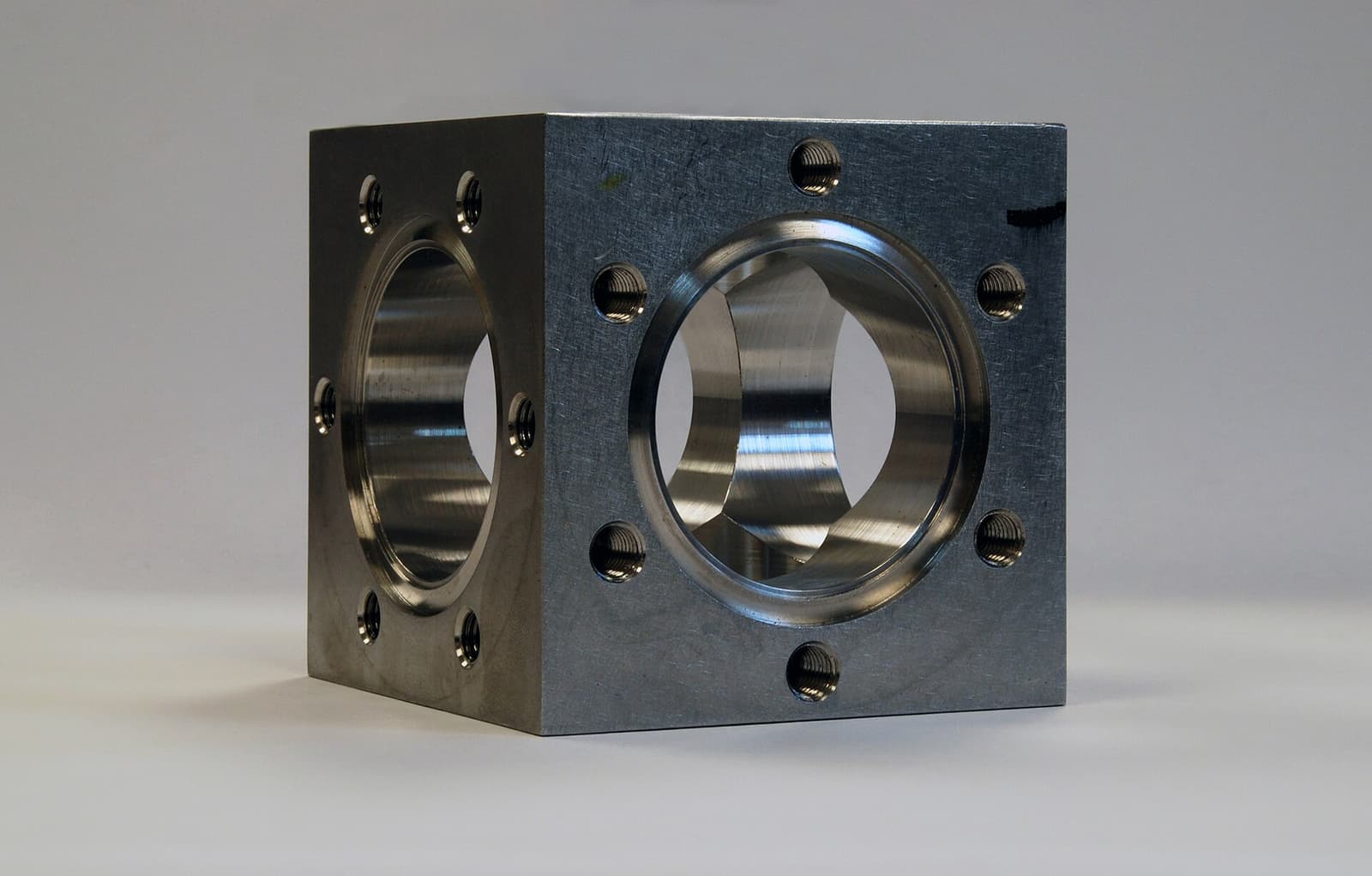

Stainless steel square hollow tube was its own line on the 2014 Alltrade homepage, sitting beside round hollows, bar and sheet. Australian trades still order it as SHS or square tube: a mill-formed box for posts, frames, furniture, gate stiles and the odd barbecue stand. It is not a folded channel. It is not a round tube. It is a closed square with a weld seam and a corner radius the drawing should respect.
This essay is how to specify it in Australia without buying a mild-steel mental model in a stainless skin.
What you are actually buying
A stainless square hollow is usually a welded tube, not a seamless extrusion. The mill forms a strip, closes a seam, heat-treats or pickles, and sometimes polishes. The outside dimension is the first number (20, 25, 30, 40, 50, 100 mm). The wall is the second. The corner is radiused. If your drawing shows a knife-edge square, the truck will not match it.
| Common Australian call-up | Typical duty | Watch-for |
|---|---|---|
| 20 × 20 × 1.2 / 1.5 | furniture, light frames | dents easily; indoor 304 is honest |
| 25 × 25 × 1.5 | light posts, racks | not a barrier post |
| 40 × 40 × 1.5 / 2.0 | frames, stands | coastal work wants 316L |
| 50 × 50 × 1.6 / 3.0 | gate stiles, posts | wall thickness changes everything |
| 100 × 100 × 2 / 3 | heavy frames | check mass, weld procedure, drainage |
Wall thickness is the number people skip. A 50 × 50 × 1.2 mm tube is a skin. A 50 × 50 × 3 mm tube is a post. They share a name and almost nothing else. Write the wall in millimetres. Do not say “standard wall.”
Grade follows the same map as sheet: 304/304L indoors, 316/316L outdoors on an Australian coast or beside a pool. See 304 versus 316 in Australia. A square post collects water on the top cap and at the base plate. That is a chloride cup. 304 is optimistic there.
Finish is mill, pickled, satin or polished. A mill hollow looks industrial. A polished hollow looks like furniture and shows every weld. Kitchen-adjacent frames often want a satin that can live next to a No. 4 bench. Coastal posts want a finish you can wash, not a mirror you cannot maintain — coastal stainless care.
Square versus folded, round and solid
Choose a mill square hollow when you need a closed box, four faces, and a predictable outside size.
Choose a folded channel when you need three sides and an open throat — a cover, a cable run, a trim.
Choose round tube when the job is a handrail, a glass slot, or a sanitary line.
Choose round bar when you need a pin or a shaft, not a post.
Choose angle when two legs are enough.
The old custom-cut shop sold all of those because Melbourne jobs mix them on one truck. Substituting a folded box with a messy seam for a mill SHS is a fabrication decision, not a saving, once you count weld dressing and the corner that never quite matches.
Water, caps and the inside you forget
A square post is a rain gauge. If the top is open, it fills. If the base is closed and undrained, it stays full. Coastal 316 still tea-stains when the inside rusts from trapped swarf and the stain weeps at every weld pore.
Specify:
- a cap or a fall
- a drain hole that can actually drain
- a base plate detail that does not make a dirt shelf
- A4 fasteners outdoors
- a blow-out after cutting, so carbon swarf is not stored in the bore
Protecting stainless during install applies to hollows more than to sheet: a grinder spark that falls inside is a brown stripe you will meet at handover.
Pool fences and marina walkways are worse than a suburban gate. Hypochlorite and salt both sit in corners. Pool and marine fittings and 316 balustrades are the neighbouring essays. A square 304 post beside a chlorinated spa is a callback.
Welding a box
You are welding a thin-wall austenitic with a seam that already exists. Add a site joint and you have two heat tints. Use 304L or 316L, matching filler, and a heat input that does not collapse the wall. Welding 304 and 316 is the procedure. Passivate after fabrication is the cleanup.
Corner welds on furniture-grade tube are visible. A mill seam that was meant to hide on the back will suddenly face the café. Mark the seam on the drawing. Dress it or hide it. Do not discover it at install.
Never weld stainless SHS with a carbon-steel wire “just to tack.” The tack becomes a rust flower.
How to write the order
Indoor frame: “304L square hollow, 25 × 25 × 1.5 mm, mill finish, cut 12 lengths at 720 mm, mill cert, ends square, blow out.”
Coastal gate stile: “316L square hollow, 50 × 50 × 3.0 mm, satin, cut 2 lengths at 1800 mm, cap one end, drain hole 50 mm above base, mill cert, A4 fasteners, passivate after fabrication.”
Furniture: “304 square tube, 20 × 20 × 1.5, satin polish, seam to rear, cut list attached.”
If the shape is a tray or a barbecue lid, you are back in custom-cut sheet, not in the hollow rack. If you are still choosing metal, start at grades and alloys. If you are choosing a section family, stay in custom-cut stainless and sections.
Rectangular cousins and the mild-steel habit
Merchants also sell rectangular hollows — 50 × 25, 75 × 50 — under the same stainless family. The specification is identical: outside sizes, wall, alloy, finish, seam face, cap and drain. Do not assume a painted mild-steel RHS chart applies. Stainless walls are often thinner for the same outside size, the corner radius is a mill fact, and the mass is not the number in a builder’s head from a galvanised gate.
If the job is a coastal balustrade with glass, square posts can work as newels while the rail stays round. Mix the alloys and the fasteners on purpose, not by leftover. A 304 square newel with a 316 rail and A2 screws is three stories in one photograph.
Square hollows look simple because they look like painted steel. They are not. Write the outside size, the wall, the alloy with an L if you will weld, the finish, the cap and the drain. That is the specification the 2014 catalogue was reaching for when it gave square tube its own line.